
What Is Stock Market in Simple words?
Imagine the stock market as a massive online marketplace where people buy and sell pieces of companies, just like you’d trade baseball cards or fruits at a bazaar. You know those big brands you love, like Apple or Reliance? When they need cash to grow, they chop up ownership of their companies into tiny shares called stocks and sell them to folks like you and me.
You can hop in by opening a trading account on apps like Upstox, Groww or Zerodha. Buy low when a company’s price dips, due to some events, bad news or some other factore, and sell when the prices increases. Prices swing daily based on news, earnings, or even global events. It’s like a rollercoaster ride fueled by millions of buyers and sellers worldwide.
How the Stock Market Works?

Primary Market
The primary market is where a company first raises money from the public. When a company such as Reliance, Tata, or Zomato wants funds to expand its business, set up new facilities, or launch new products, it issues fresh shares through an Initial Public Offering (IPO).
In an IPO, investors buy shares directly from the company for the first time. Investment banks and regulatory bodies help determine the issue price, and investors apply for shares through platforms linked to the National Stock Exchange (NSE) or Bombay Stock Exchange (BSE). The money raised through this process goes directly to the company and is used for its growth and operations. This fundraising event happens only once for each set of newly issued shares.
Secondary Market
After the IPO, the shares are listed on stock exchanges such as the NSE and BSE. This is known as the secondary market. Here, investors buy and sell shares among themselves on a daily basis. The company does not receive any money from these transactions.
Stock prices in the secondary market are determined by supply and demand. If more investors want to buy a stock, its price rises. If more investors want to sell, the price falls. Prices change regularly based on factors such as company performance, financial results, economic news, and market conditions.
The secondary market allows investors to earn returns over time by buying shares at lower prices and selling them at higher prices, or by holding quality stocks for long-term wealth creation.
DIFFERENCE BETWEEN PUBLIC COMPANY AND PRIVATE COMPANY
A public company allows anyone to buy its shares through stock exchanges. As a result, ownership is open to the general public, and there is no maximum limit on the number of shareholders. In contrast, a private company keeps its shares within a small group, such as founders, family members, or selected investors. It limits the number of shareholders to 200 and restricts the transfer of shares to maintain control.
Public companies must follow strict regulations. They are required to disclose their financial statements regularly, appoint at least three directors including independent directors, and include the words “Public Limited” in their company name. Private companies have fewer regulatory requirements. They need only two directors, are not required to disclose financial information publicly, and use “Private Limited” in their name. This allows private companies to maintain confidentiality and make decisions more quickly.
There are also differences in how these companies raise funds. Public companies can raise capital by issuing shares to the public through prospectuses, which allows them to access large amounts of funding. These shares can be easily bought and sold on stock exchanges. Private companies raise funds through private placements, which can be more limited but allow greater flexibility in operations.
Both public and private companies serve different purposes and are suitable for different stages of business growth, as defined under laws such as India’s Companies Act.
HOW ARE SHARE BOUGHT AND SOLD
To buy shares, you first need to open an account with a stockbroker. The broker connects you to a stock exchange such as the National Stock Exchange or the Bombay Stock Exchange. You then place an order by selecting the company’s shares, the number of shares you want to buy, and the price you are willing to pay. This price is called a bid.
At the same time, sellers place their orders with an asking price, which is the minimum price they are willing to accept. When a buyer’s bid matches a seller’s asking price, the stock exchange automatically executes the trade. The shares are credited to the buyer’s account, and the money is transferred to the seller’s account. This process usually settles within two business days.
Selling shares follows the same process in reverse. You instruct your broker to sell your shares at a chosen price. Once a buyer agrees to that price, the trade is completed, and the sale amount is credited to your account after applicable charges.
Share prices change continuously due to factors such as supply and demand, company performance, and market news, making timing an important factor in investing.
What Is a Stock Exchange?
A stock exchange is a regulated platform where people buy and sell shares of publicly listed companies, along with other securities like bonds. It connects companies seeking funds with investors willing to purchase ownership stakes, ensuring transactions occur transparently through electronic systems. Brokers submit orders on behalf of clients, and computers match buyers with sellers based on price and volume, determining fair market values.
In places like India’s BSE or NSE, or global ones such as the NYSE, trading happens during set hours under oversight from bodies like SEBI to protect participants and maintain order. Companies list shares here to raise capital for expansion without direct borrowing, while investors trade to build wealth or adjust portfolios. This setup provides liquidity, meaning shares convert to cash quickly, and real-time pricing reflects supply-demand dynamics. Overall, stock exchanges drive economic growth by channeling savings into productive businesses.
Other instrument traded on stock market
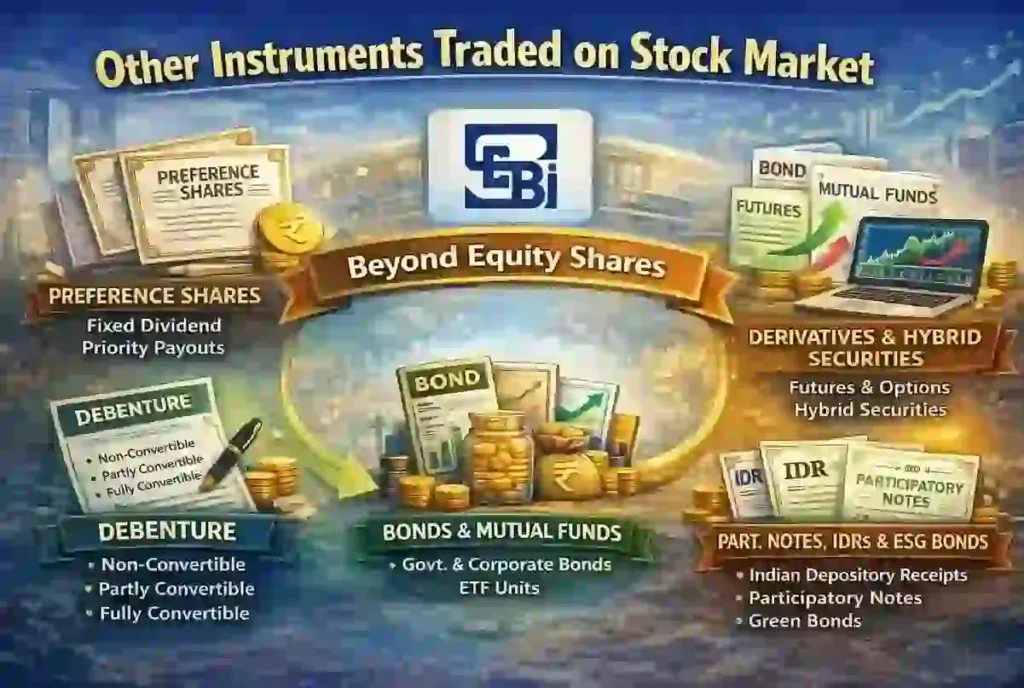
Indian stock exchanges like NSE and BSE trade a variety of securities beyond equity shares. These include preference shares with fixed dividends and priority payouts, various debentures such as non-convertible, partly convertible, and fully convertible types, as well as warrants and secured premium notes.
Other instruments feature bonds, including government securities and corporate bonds, units of mutual funds, and exchange-traded funds like gold or commodity ETFs. Derivatives such as futures and options on indices, stocks, currencies, and commodities are actively traded, alongside hybrid securities that blend debt and equity traits.
Indian Depository Receipts from foreign companies, participatory notes, and even ESG or green bonds round out the list, offering diverse investment avenues under SEBI regulation.
WHAT ARE INDICES
Stock market indices track the performance of a selected group of stocks, acting as benchmarks for overall market health. They use weighted averages of share prices to reflect trends in specific sectors, regions, or the broader economy.
Key Types
- Benchmark Indices: Represent the entire market with top companies.
- Sectoral Indices: Focus on industries like banking or IT.
- Market Cap Indices: Group stocks by company size, such as large-cap or mid-cap.
Examples
| Index | Exchange | Description |
| Nifty 50 | NSE | Top 50 companies by market cap |
| Sensex | BSE | 30 largest, blue-chip firms |
| S&P 500 | US | 500 leading U.S. companies |
| Nifty Bank | NSE | Banking sector performance |
Important terminologies
Bull Market: A period when stock prices rise steadily due to optimism and strong economic signals. Investors gain confidence, leading to higher buying activity and broader market growth.
Bear Market: A phase where stock prices fall significantly over months, often from economic downturns. Selling pressure dominates as pessimism spreads among participants.
Dividend: Payments companies make to shareholders from profits, usually quarterly. They provide steady income alongside potential capital appreciation.
IPO (Initial Public Offering): The first sale of a company’s shares to the public to raise funds. It transitions private firms to public status under exchange listing.
P/E Ratio: Price-to-earnings ratio measures a stock’s price relative to per-share earnings. Lower values suggest undervaluation, aiding value investment decisions.
Market Order: An instruction to buy or sell a stock immediately at the current market price. Execution prioritizes speed over exact pricing control.
Limit Order: A directive to trade only at a specified price or better, offering precision. It avoids unfavorable fills but risks non-execution if unmet.
Stop Loss: An automatic sell order triggered when a stock hits a set lower price. It caps losses during adverse moves while allowing gains.
ETF (Exchange-Traded Fund): A fund mirroring an index or sector, traded like stocks on exchanges. It diversifies holdings cost-effectively with intraday liquidity.
Index: A benchmark tracking a group of stocks, like Nifty 50 or Sensex in India. It gauges overall market performance and guides portfolio benchmarks.
For beginners, we have also created a free PDF covering over 70 key stock market terms commonly used. You Can Download it for Free
How can you invest in the stock market?

To invest in the stock market, you must first open a Demat account, which holds your shares in electronic form. You also need a linked trading account that allows you to buy and sell shares. Choose a broker registered with the Securities and Exchange Board of India, such as Zerodha or Angel One. You will need to submit documents like your PAN card, Aadhaar card, bank details, and address proof for KYC verification. This process is completed online and is usually paperless, allowing the account to be opened quickly, often within one day.
After your account is approved, transfer funds from your bank account to your trading account using options such as UPI or net banking. Then, log in to the broker’s website or mobile application and research stocks using the available tools. You can review company performance, financial health, and other factors to ensure they align with your investment goals.
To invest, place a buy order by selecting the stock, the number of shares, and the order type, such as a market order or a limit order. Once the transaction is completed, the shares are credited to your Demat account, usually by the next business day under the T+1 settlement system.
It is important to monitor your portfolio regularly, add funds when required, and sell shares when your investment goals are achieved. Focusing on long-term growth rather than daily price movements can help you build wealth in a systematic and secure manner.
Advantages of the Stock Market
The stock market allows companies to raise capital by issuing shares. This helps them fund business expansion and daily operations without relying heavily on loans. As a result, companies can innovate, create jobs, and strengthen their position in the market.
Investors benefit by building wealth through an increase in share prices and by earning dividends. Over the long term, stock market investments often grow faster than inflation. Investors also enjoy liquidity, as shares can be sold quickly when funds are needed.
Employees may benefit through stock options or Employee Stock Ownership Plans. These incentives link employee rewards with company performance and encourage higher motivation and long-term commitment.
Retirees and pension funds use the stock market to achieve long-term financial growth. Diversified investments, such as index funds and well-established companies, help reduce risk while supporting stable returns.
Brokers and financial advisors earn income through commissions and service fees. Regulatory bodies like the Securities and Exchange Board of India ensure transparency and fair practices, which contributes to overall economic stability through monitored growth and tax revenues.
Why Is the Stock Market Important?
The stock market plays a key role in the economy by directing savings from individuals to companies that need funds for growth. This process supports innovation, business expansion, and job creation while allowing companies to raise money without excessive borrowing. At the same time, investors grow their wealth through rising share values and dividends, helping them stay ahead of inflation.
The stock market also acts as an indicator of economic health. Movements in major indices such as the Nifty and Sensex reflect investor confidence and help guide business and policy decisions. Liquidity in the stock market allows assets to be converted into cash easily, encouraging spending and contributing to economic growth. In India, the stock market supports infrastructure development, business ownership through equity, and retirement planning, helping maintain financial stability without increasing debt.
Leave a Reply