What Is NIFTY 50: Meaning, Definition, and Overview
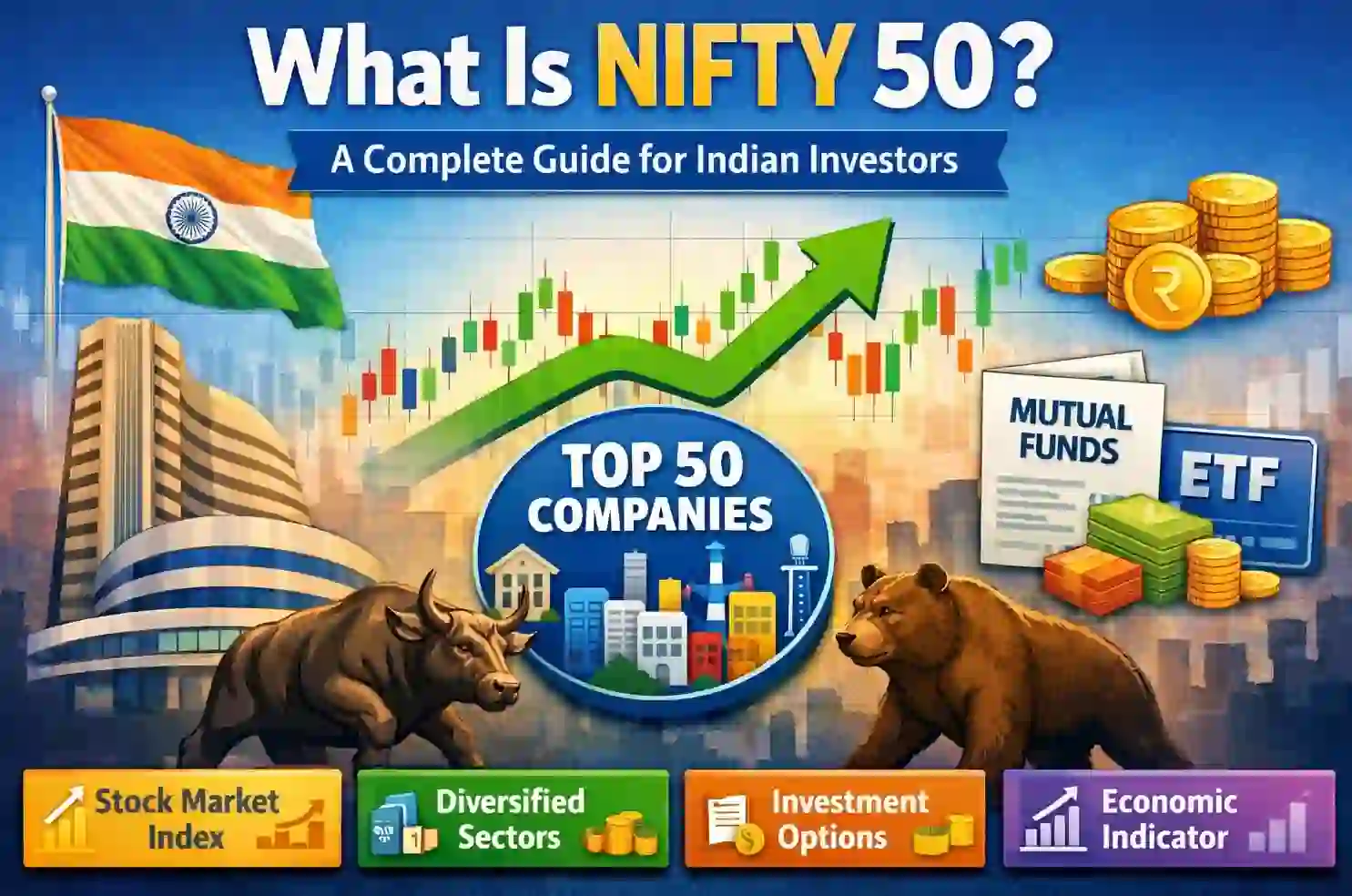
The NIFTY 50 is the most important stock market index in India. It shows how the top 50 largest and strongest companies in the country are performing on the National Stock Exchange. These companies come from different sectors such as banking information technology oil and gas telecom and consumer goods. Because of this wide coverage the NIFTY 50 gives a clear picture of the overall Indian stock market.
The word NIFTY comes from combining two words National and Fifty. National refers to the National Stock Exchange and Fifty represents the 50 companies included in the index. When people say the market is going up or down they are often talking about the movement of the NIFTY 50.
The NIFTY 50 was officially launched on 22 April 1996. It uses a base value of 1000 which was set on 3 November 1995. The index is managed by NSE Indices Limited which is a subsidiary of the National Stock Exchange. Over time the NIFTY 50 has become the main benchmark used by investors fund managers and analysts to measure the performance of the Indian equity market.
This index is calculated using a free float market capitalization method. This means it only considers shares that are freely available for trading in the market and ignores promoter or government held shares. Because of this the index reflects real market activity and liquidity.
The NIFTY 50 represents around sixty percent of the total market value of all companies listed on the NSE. Due to its size and influence it is widely used for index mutual funds exchange traded funds futures and options trading. Products like Nifty BeES directly track this index.
In simple terms the NIFTY 50 acts like a report card for the Indian stock market. If the NIFTY 50 is rising it usually means large Indian companies are performing well and investor confidence is strong. If it falls it often signals weakness or uncertainty in the market. This is why understanding the NIFTY 50 is important for anyone interested in investing in Indian stocks.
How the NIFTY 50 Index Works
The NIFTY 50 index works by tracking the performance of India’s 50 largest and most actively traded companies listed on the National Stock Exchange. Instead of looking at the share price of just one company, the index combines the value of all 50 companies to show the overall direction of the stock market.
When most companies in the index perform well, the NIFTY 50 goes up. When many of them fall, the index goes down. This makes NIFTY 50 a reliable indicator of how the Indian stock market is performing as a whole.
Free Float Market Capitalization Explained
NIFTY 50 uses a free float market capitalization method. This means the index only considers shares that are available for public trading. Shares held by promoters, governments, or founders that are not regularly traded are ignored.
This approach ensures that only the investable portion of a company is counted. As a result, companies with higher publicly traded shares have a bigger impact on the index movement. This method gives a more realistic picture of market activity and investor participation.
How the NIFTY 50 Value Is Calculated
The value of the NIFTY 50 is calculated by combining the free float market value of all 50 companies in the index. Companies with larger market value influence the index more than smaller ones.
For example, large companies like banks, IT firms, and energy companies affect the index more because of their size and trading volume. Smaller companies still matter, but their impact is limited. This weighted approach keeps the index stable and prevents sharp movements due to small stocks.
Rebalancing and Review Process
The NIFTY 50 index is reviewed twice every year to ensure it remains accurate and relevant. During this review, companies are checked for market size, liquidity, and trading activity.
If a company no longer meets the required criteria, it can be removed from the index. At the same time, a stronger and more eligible company may be added. This process helps the index reflect current market leaders and removes underperforming stocks.
Regular rebalancing keeps the NIFTY 50 updated with India’s changing economy and ensures it continues to represent the top companies in the stock market.
Key Features and Importance of NIFTY 50
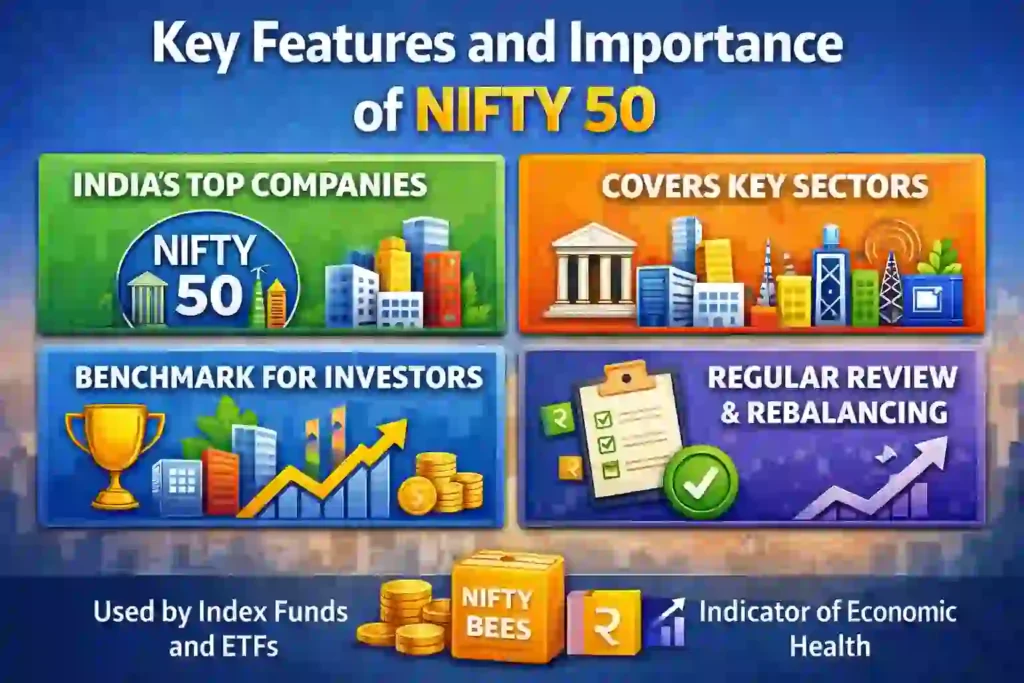
The NIFTY 50 is not just a stock market index. It plays a very important role in how investors understand and track the Indian stock market. Below are the key features that explain why the NIFTY 50 matters so much.
Represents India’s Leading Companies
The NIFTY 50 includes the top fifty large and financially strong companies listed on the National Stock Exchange. These companies are selected based on their market size and liquidity. Because of this, the index represents nearly two thirds of the total free float market value of the NSE. When NIFTY 50 moves up or down, it usually reflects the overall direction of the Indian equity market.
Covers Multiple Key Sectors
One of the biggest strengths of NIFTY 50 is diversification. The index includes companies from more than thirteen major sectors such as banking, financial services, information technology, oil and gas, telecom, pharmaceuticals, consumer goods, and metals. This wide sector coverage reduces dependence on a single industry and gives investors exposure to the broader economy.
Free Float Market Capitalization Method
The NIFTY 50 uses a free float market capitalization method. This means only the shares available for public trading are considered while calculating the index value. Promoter holdings and locked in shares are excluded. This makes the index more realistic and investable, as it focuses on shares that are actually traded in the market.
Regular Review and Rebalancing
The index is reviewed and rebalanced twice every year. During this process, companies that no longer meet the eligibility criteria can be removed, and stronger companies can be added. This ensures that NIFTY 50 always includes the most relevant and high performing large cap companies in India.
Acts as a Market Benchmark
NIFTY 50 is widely used as a benchmark by mutual funds, portfolio managers, and individual investors. Many equity funds compare their performance against NIFTY 50 to measure how well they are doing. If a fund consistently beats NIFTY 50, it is considered to be performing well.
Foundation for Index Funds and ETFs
Most NIFTY index funds and exchange traded funds are designed to replicate the performance of NIFTY 50. Investors who do not want to pick individual stocks can invest in these funds and still benefit from the growth of top Indian companies. Products like Nifty BeES are built directly on the NIFTY 50 index.
Indicator of Economic Health
Since the index includes leaders from major industries, NIFTY 50 is often seen as an indicator of India’s economic health. Rising index levels usually signal economic growth and investor confidence, while sharp declines may indicate economic or global uncertainty.
Suitable for Long Term Investors
Over the long term, NIFTY 50 has delivered steady returns by capturing India’s economic growth. Because it includes stable and established companies, it is considered suitable for long term investors who want consistent wealth creation with relatively lower risk compared to mid cap or small cap stocks.
Eligibility Criteria for NIFTY 50 Index Listing
The Eligibility Criteria for NIFTY 50 Index Listing are the rules set by NSE Indices to ensure that only the strongest, most reliable, and highly traded companies become part of India’s benchmark index. These rules help maintain the quality, stability, and credibility of the NIFTY 50.
Basic Listing Requirements
To be considered for inclusion in the NIFTY 50 index, a company must be listed on the National Stock Exchange of India. It should be an Indian company and must be available for trading in the Futures and Options segment. The company should also have a minimum listing history of one month on the NSE, ensuring that it has enough trading data for evaluation.
Regular trading activity is essential. The company’s shares must have traded on all trading days during the previous six months. In special cases involving newly listed companies, slightly relaxed conditions may apply, but consistent trading remains a key requirement.
Liquidity Requirements
Liquidity means how easily a stock can be bought or sold without causing major price changes. For NIFTY 50 eligibility, the company’s shares must be highly liquid. This is measured using a concept called impact cost, which reflects the price movement caused by large trades.
To qualify, the stock must show low impact cost levels for most trading days over the last six months. This ensures that large investors can trade the stock easily and that the index remains practical for funds, ETFs, and derivatives linked to NIFTY 50.
Market Capitalization Criteria
Market capitalization plays a crucial role in selecting NIFTY 50 companies. The index focuses on free float market capitalization, which means only the shares that are freely available for public trading are considered.
To be eligible, a company’s average free float market value over the past six months must be significantly higher than that of the smallest company already included in the NIFTY 50. This rule ensures that only large and financially strong companies form part of the index.
In addition, the company must have a minimum percentage of shares available for public trading. This ensures broad investor participation and avoids concentration in a few hands.
Selection and Review Process
Eligible companies are ranked based on their average free float market capitalization over the last six months. The top fifty companies from this ranking become part of the NIFTY 50 index.
The index is reviewed twice a year, usually in January and July. During this process, companies that no longer meet the eligibility criteria may be removed, and better performing eligible companies may be added. Quarterly checks are also conducted to ensure ongoing compliance with trading and liquidity requirements.
Shares with differential voting rights can be included if they meet all eligibility and liquidity conditions.
Top Companies Listed in NIFTY 50
The NIFTY 50 index includes the fifty largest and most financially strong companies listed on the National Stock Exchange. These companies are leaders in their industries and play a major role in India’s economy. They come from different sectors such as banking, information technology, energy, telecom, and consumer goods.
Because these companies have large market value and high trading activity, they carry more weight in the index. This means their share price movements have a bigger impact on how the NIFTY 50 moves on a daily basis.
Leading Companies in the NIFTY 50
| Ranking by Market Cap | Company |
| 1 | Reliance Industries |
| 2 | HDFC Bank |
| 3 | Bharti Airtel |
| 4 | Tata Consultancy Services |
| 5 | ICICI Bank |
| 6 | State Bank of India |
| 7 | Infosys |
| 8 | Bajaj Finance |
| 9 | Hindustan Unilever |
| 10 | Larsen & Toubro |
| 11 | Maruti Suzuki |
| 12 | Mahindra & Mahindra |
| 13 | HCL Technologies |
| 14 | Kotak Bank |
| 15 | Axis Bank |
| 16 | ITC |
| 17 | Sun Pharmaceutical |
| 18 | UltraTech Cement |
| 19 | Titan |
| 20 | Adani Ports & SEZ |
| 21 | NTPC |
| 22 | Oil & Natural Gas Corporation |
| 23 | Bajaj Finserv |
| 24 | Bharat Electronics |
| 25 | JSW Steel |
| 26 | Eternal |
| 27 | Power Grid Corporation of India |
| 28 | Coal India |
| 29 | Bajaj Auto |
| 30 | Adani Enterprises |
| 31 | Nestle |
| 32 | Tata Steel |
| 33 | Wipro |
| 34 | Asian Paints |
| 35 | Hindalco Industries |
| 36 | SBI Life Insurance |
| 37 | Eicher Motors |
| 38 | Grasim Industries |
| 39 | Interglobe Aviation |
| 40 | Shriram Finance |
| 41 | Jio Financial Services |
| 42 | Tech Mahindra |
| 43 | HDFC Life Insurance |
| 44 | Trent |
| 45 | Tata Motors Passenger Vehicles |
| 46 | Tata Consumer Products |
| 47 | Cipla |
| 48 | Dr Reddys Laboratories |
| 49 | Apollo Hospitals |
| 50 | Max Healthcare Institute |
The ranking may change depending on stock market performance and reflects data recorded as of 8 February 2026.
Sector Wise Representation
The banking and financial services sector has the highest share in the NIFTY 50. This is because banks and financial institutions form the backbone of the Indian economy.
The information technology sector is another important part of the index. IT companies benefit from global demand and provide stability during different economic cycles.
Energy and oil and gas companies also hold a significant position, reflecting India’s growing energy needs. Telecom, consumer goods, pharmaceuticals, and infrastructure sectors add further balance to the index.
Why These Companies Matter to Investors
The companies included in the NIFTY 50 are known for their stability, strong management, and long term growth potential. Since these are large and trusted businesses, they are less risky compared to smaller companies.
Investing in NIFTY 50 means indirectly investing in all these top companies at the same time. This reduces the risk of depending on a single company and provides steady growth over the long term.
History and Performance of NIFTY 50
The journey of NIFTY 50 started in nineteen ninety six when the National Stock Exchange introduced it as India’s main stock market index. The idea was simple. Track the performance of the fifty largest and most reliable companies to understand how the overall market is doing. The base value was fixed at one thousand, using November nineteen ninety five as the starting point.
In the late nineteen nineties and early two thousands, the index was largely driven by public sector banks, oil companies, and traditional manufacturing firms. As India’s economy opened up, private banks and technology companies slowly began to play a bigger role in the index.
The year two thousand eight was a difficult phase for NIFTY 50. The global financial crisis caused markets around the world to fall sharply, and India was no exception. NIFTY 50 dropped heavily during this period, but it later recovered as the economy stabilized and confidence returned.
In two thousand nine, an important improvement was made to the index calculation. NIFTY 50 shifted to the free float market capitalization method. This change made the index more practical because it started counting only those shares that were actually available for public trading.
By two thousand seventeen, NIFTY 50 crossed the ten thousand level for the first time. This reflected strong economic growth, rising corporate profits, and increasing participation from domestic and foreign investors.
Another major test came in two thousand twenty during the COVID pandemic. Markets fell sharply due to lockdowns and uncertainty. However, the recovery was faster than expected, supported by strong banking, technology, and consumer companies.
In the mid two thousand twenties, NIFTY 50 reached new highs, showing the strength of India’s large companies even during global challenges. Over long periods, the index has delivered average yearly returns of around twelve to fifteen percent, making it a dependable option for long term investors.
The overall history of NIFTY 50 shows that while short term ups and downs are normal, long term growth remains strong when investors stay patient and invested.
What Is Nifty BeES?
Nifty BeES is an Exchange Traded Fund that allows investors to invest in the NIFTY 50 index in a simple and low cost way. The term BeES stands for Benchmark Exchange Traded Scheme. It was launched in December 2001 by Nippon India Mutual Fund and is known as India’s first ETF.
Nifty BeES is designed to copy the performance of the NIFTY 50 index. This means when the NIFTY 50 goes up, the value of Nifty BeES also rises, and when the index falls, its value declines as well. Instead of buying shares of all 50 companies separately, investors can buy a single unit of Nifty BeES and get exposure to all NIFTY 50 companies at once.
Each unit of Nifty BeES represents a small portion of the NIFTY 50 index, making it affordable even for small investors. The fund follows a passive investment strategy, so the fund manager does not try to beat the market. The goal is simply to match the returns of the NIFTY 50 index as closely as possible.
Nifty BeES is traded on the stock exchange just like a regular share. Investors can buy and sell it during market hours using a demat and trading account. Since it is exchange traded, prices change throughout the day based on demand and supply.
One of the biggest advantages of Nifty BeES is its low cost. The expense ratio is usually much lower than actively managed mutual funds. This helps investors keep more of their returns over the long term. However, returns may be slightly lower than the index due to small expenses and tracking error.
Overall, Nifty BeES is a simple, transparent, and efficient way for investors to participate in the growth of India’s top 50 companies without the need to select individual stocks.
Benefits of Investing in NIFTY 50

Investing in NIFTY 50 is considered one of the simplest and safest ways to participate in the Indian stock market, especially for long term investors. Since the index represents the top 50 companies in India, it offers several practical benefits.
Diversification across strong companies
NIFTY 50 includes companies from multiple sectors such as banking, IT, energy, telecom, and consumer goods. This means your money is spread across different industries instead of being dependent on a single company or sector. Even if one sector performs poorly, others can balance the impact.
Exposure to India’s biggest and most stable businesses
The index consists of large, well established companies like leading banks, IT firms, and industrial giants. These businesses have strong financials, proven management, and long operating histories, which reduces the risk compared to investing in small or unknown companies.
Low cost investing
NIFTY 50 index funds and ETFs are passively managed, which means there is no active stock picking. As a result, the expense ratio is much lower compared to regular mutual funds. Lower costs help investors keep more of their returns over time.
Consistent long term growth potential
Historically, NIFTY 50 has delivered steady long term returns despite short term ups and downs. Market crashes and corrections do happen, but the index has always recovered over time, making it suitable for long term wealth creation.
No need to pick individual stocks
Selecting winning stocks requires deep knowledge, time, and constant tracking. By investing in NIFTY 50, you automatically invest in the best performing large cap companies without worrying about choosing or managing individual stocks.
High liquidity and transparency
NIFTY 50 stocks and related investment products are highly liquid, meaning they can be easily bought or sold during market hours. The index composition, weightage, and performance are publicly available, ensuring full transparency for investors.
Ideal for SIP and passive investors
NIFTY 50 is well suited for systematic investment plans, allowing investors to invest small amounts regularly. This helps in managing market volatility and builds disciplined investing habits, especially for beginners.
Suitable for most types of investors
Whether you are a beginner, a salaried professional, or a long term investor planning for future goals, NIFTY 50 offers a balanced and reliable investment option without the complexity of active trading.
How Can You Invest in NIFTY 50?
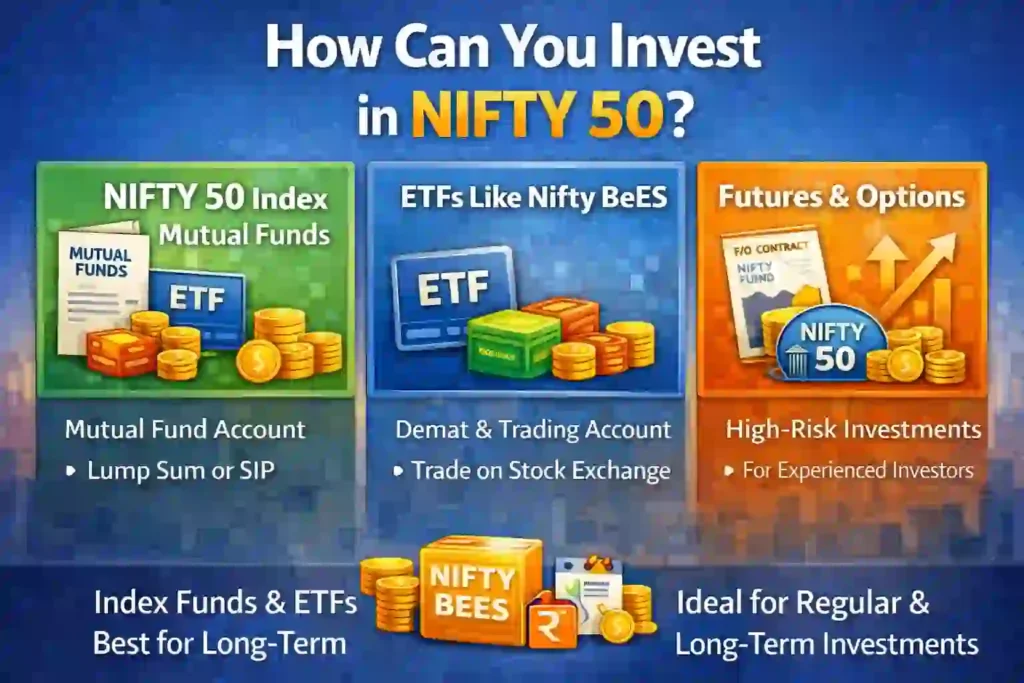
Investing in the NIFTY 50 is simple and suitable even for beginners. You do not need to buy shares of all 50 companies individually. Instead, you can invest through financial products that track the NIFTY 50 index and give you exposure to all its companies at once.
Investing Through NIFTY 50 Index Mutual Funds
NIFTY 50 index mutual funds are designed to copy the performance of the NIFTY 50 index. These funds invest in the same 50 companies and in the same proportion as the index.
To invest, you need a mutual fund account, which you can open online through fund house websites or investment apps. You can invest a lump sum amount or start a SIP, where a fixed amount is invested every month. SIPs are ideal for long term investors because they reduce market timing risk and help build wealth gradually.
Index mutual funds have low expense ratios because they are managed passively. Over the long term, they aim to deliver returns similar to the NIFTY 50, minus a small cost.
Investing Through ETFs Like Nifty BeES
Exchange Traded Funds or ETFs such as Nifty BeES also track the NIFTY 50 index. These trade on the stock exchange just like shares.
To invest in Nifty BeES, you need a demat and trading account. You can buy or sell ETF units during market hours at real time prices. ETFs offer flexibility and transparency, as prices change throughout the day based on market demand and supply.
ETFs usually have very low costs, but their market price may slightly differ from the actual index value due to demand and supply.
Investing Through Futures and Options
Experienced investors can invest in NIFTY 50 through futures and options contracts. These are derivative instruments used mainly for trading or hedging purposes.
This method involves higher risk and requires a good understanding of the market. It is not recommended for beginners or long term passive investors.
Direct Investment Is Not Possible
You cannot invest directly in the NIFTY 50 index itself. The index is only a measurement tool. You can invest only through products like index funds, ETFs, or derivatives that track the index.
Which Option Is Best for You?
If you are a beginner or a long term investor, NIFTY 50 index mutual funds and ETFs are the best choices. Index funds are better for those who prefer simple investing and SIPs. ETFs are suitable for investors who already have a demat account and want more control over buying and selling.
Conclusion – Why NIFTY 50 Is the Backbone of Indian Equity Markets
The NIFTY 50 is more than just a stock market index. It represents the overall health and direction of the Indian equity market. By tracking the top 50 largest and most reliable companies across key sectors, it gives investors a clear picture of how India’s economy is performing.
For beginners, the NIFTY 50 offers a simple and safe way to understand the stock market without getting lost in individual stock selection. For experienced investors, it acts as a trusted benchmark to measure portfolio performance and make informed investment decisions. Since it covers a large portion of the market and includes industry leaders, its movement reflects real changes in business growth, investor confidence, and economic trends.
The NIFTY 50 has also proven its strength over time. Despite market crashes and economic slowdowns, it has consistently recovered and delivered steady long-term growth. This makes it a strong foundation for long-term wealth creation through index funds and ETFs.
Leave a Reply