
How to Invest in Stock Market for Beginners
Investing in the stock market is one of the most powerful ways to grow your money over time. Instead of just saving money in a bank account, investing allows your money to work for you. Over the long term, the stock market has helped investors build wealth, beat inflation, and achieve important financial goals like buying a house, funding children’s education, or planning for retirement. If you are wondering how to invest in share market for beginners or looking for practical ways how to invest money in share market, understanding the basics is the first and most important step.
For beginners, the stock market may look confusing or risky. Many people want to learn how to start investing in stock market but feel overwhelmed by terms like Demat account, trading account, brokerage, and market orders. Some are also curious about how to start trading in share market but are unsure where to begin. The good news is that once you understand the fundamentals and follow a clear step by step approach, investing becomes much simpler than it seems.
This guide is specially written for beginners in India who want to start investing in the right way. Whether your goal is learning how to start investing in stock market, understanding how to start trading in share market, or simply knowing how to invest money in share market safely, this guide will help you. You will learn how to choose a reliable broker, open your Demat and trading account, decide your financial goals, add funds, understand the trading platform, and place your first stock order confidently.
By the end of this article, you will have a clear roadmap to start your stock market journey safely and smartly, even if you have zero prior experience.
Step 1 – Select a Reputable Stock Broker
Before you can buy your first stock, you need a stock broker. A broker is a company that allows you to buy and sell shares through its platform. Think of a broker as a bridge between you and the stock exchange.
Choosing the right broker is very important because your money, shares, and personal details will be handled through this platform. Always choose a broker that is registered with SEBI and is a member of NSE or BSE. This ensures your investments are safe and regulated.
Types of Stock Brokers in India

There are two main types of brokers in India.
Discount Brokers
Discount brokers offer low brokerage charges and simple online platforms. They are best for beginners who want to invest on their own without paying high fees.
Examples include Zerodha, Groww, and Upstox.
Advantages
- Low or zero brokerage for delivery trades
- Simple and easy mobile apps
- Quick online account opening
Limitations
- Limited research reports
- No personal relationship manager
If you are comfortable learning and making your own decisions, a discount broker is usually the best choice.
Full Service Brokers
Full service brokers offer extra services like stock research, advisory support, portfolio analysis, and relationship managers.
Examples include ICICI Direct, HDFC Securities, and Angel One.
Advantages
- Research reports and stock recommendations
- Personalized support
- Guidance for beginners
Limitations
- Higher brokerage charges
- Fees can increase if you trade frequently
If you want regular guidance and are willing to pay higher fees, a full service broker may suit you.
How to Compare Brokers
Before selecting a broker, compare them based on the following important factors.
Brokerage Charges
Check delivery, intraday, and derivatives charges. Many discount brokers offer zero brokerage for delivery and a flat fee for other trades. Lower charges help you save money in the long run.
Account Opening and AMC
Most discount brokers offer free account opening. Some charge Annual Maintenance Charges for the Demat account. Compare yearly costs before deciding.
Platform Usability
The broker’s mobile app and website should be simple and easy to use. A clean dashboard, fast order execution, and easy navigation are important for beginners.
Research and Tools
If you want stock reports, screeners, and educational material, check what the broker provides. Some platforms offer learning resources for beginners.
Customer Support
Good customer support is important in case you face technical or account issues. Check if they provide chat, phone, or email support and read recent user reviews.
SEBI Registration
Always confirm that the broker is registered with SEBI. You can verify this on the official SEBI website. Never open an account with an unregistered company.
Popular Beginner Friendly Brokers in India
Here are some widely used brokers among new investors.
Zerodha
Known for low brokerage and a powerful trading platform called Kite. It also offers educational content through Zerodha Varsity.
Groww
Very simple app interface, suitable for complete beginners. Offers investing in stocks and mutual funds in one place.
Upstox
Low cost broker with a fast trading app and good features for active traders.
Each of these brokers is SEBI registered and widely trusted by Indian investors.
Check the complete list of stock Broker
Choose a broker based on your comfort level, cost preference, and whether you need guidance or want to invest independently. Taking time to select the right broker builds a strong foundation for your investing journey.
Step 2 – Open a Demat and Trading Account
Before you can buy shares, you need two accounts. A Demat account stores your shares in digital form, and a Trading account allows you to buy and sell those shares on the stock exchange. Most brokers in India open both accounts together through a simple online process.
What Is a Demat Account
A Demat account holds your shares electronically. When you buy a stock, it is stored safely in this account. When you sell it, the shares are removed from here. It works like a digital locker for your investments.
What Is a Trading Account
A Trading account is used to place buy and sell orders in the stock market. It connects your bank account to the stock exchange so you can invest smoothly.
Documents Required
To open your account, you usually need
PAN card
Aadhaar card
Bank account details
Active mobile number and email
Simple Account Opening Process
First, visit your broker’s website or app and click on open account.
Second, enter your basic details and upload documents.
Third, complete online verification through Aadhaar OTP or video KYC.
Finally, e sign the required forms.
Most accounts are activated within one to three working days.
Important Charges to Know
Account opening is usually free with discount brokers.
There may be a yearly maintenance charge for the Demat account.
Brokerage is charged when you buy or sell shares.
You can choose a reliable broker and complete the process online in just a few minutes. For a detailed step by step guide with platform specific instructions, read our full Demat account opening article.
Step 3 – Decide Your Financial Goal (Investing vs Trading)
Before putting money into the stock market, be clear about your purpose. Are you trying to build wealth slowly over time, or are you looking to earn short-term profits? Your answer will decide your strategy, risk level, and even the type of stocks you choose.

Difference Between Investing and Trading
Investing means buying good companies and holding them for many years. The goal is long-term growth and earning returns through price increase and dividends. It requires patience and basic knowledge of company fundamentals.
Trading means buying and selling stocks within a short period, sometimes on the same day. The goal is to earn profit from price movements. It requires regular monitoring, technical analysis skills, and a higher risk appetite.
For most beginners, investing is the safer and more practical starting point.
Set Clear Financial Goals
Ask yourself why you want to invest. It could be for retirement, buying a house, building wealth, or funding your child’s education. Set a clear target amount and time period. For example, investing a fixed amount every month for ten years to create a specific corpus.
Clear goals help you stay disciplined and avoid emotional decisions.
Decide How Much to Invest
Only invest money that you do not need for daily expenses. Build an emergency fund first that covers at least six months of expenses. Start small and increase gradually as you gain confidence.
A simple rule for beginners is to avoid putting all your money into one stock. Diversification reduces risk and protects your capital.
Once your goal and amount are clear, you can move forward with confidence.
Step 4 – Add Funds to Your Trading Account
After your Demat and trading account is activated, the next step is to add money so you can start investing. Think of it as loading your wallet before shopping. Most brokers in India make this process simple and fast.
Ways to Add Money
You can transfer funds using:
- UPI – The fastest method. Money is usually added within minutes.
- Net Banking – Safe and reliable for larger amounts.
- IMPS or Bank Transfer – Useful if UPI limit is crossed.
Most discount brokers do not charge any fee for adding funds.
Things to Keep in Mind
- Start with a small amount if you are a beginner, such as five to ten thousand rupees.
- Transfer funds before market hours if you plan to trade the same day. Markets open at 9:15 AM.
- Keep a small extra balance to cover brokerage and government charges.
Once the money reflects in your account balance, you are ready to place your first trade.
Step 5 – Understand the Trading Dashboard
After adding funds, the next important step is to understand your broker’s trading dashboard. This is the main screen where you track stocks, place orders, and monitor your investments. Spend some time exploring it before making your first trade.
Important Sections in Broker App
Market Overview
This section shows live updates of major indices like Nifty 50 and Sensex. You can also see top gainers, top losers, and market trends. It helps you understand whether the market is rising or falling.
Search and Stock Quotes
Use the search bar to find any company by typing its name or symbol. You can check the current price, daily high and low, and basic company details.
Charts
Charts show how a stock price is moving over time. Beginners can start with simple daily or weekly charts to understand price trends. Advanced indicators can be learned later.
Watchlist
The watchlist lets you save selected stocks so you can track them easily without searching again and again. Add 10 to 15 stocks you are interested in.
Order Window
This is where you buy or sell shares. You will see options like market order, limit order, and stop loss. Always check quantity and price before confirming your order.
Holdings or Portfolio
This section shows the shares you already own. You can see your profit or loss and overall investment value.
Order Types You Must Know
Market Order
Your order gets executed immediately at the current market price.
Limit Order
You set the price at which you want to buy or sell. The order executes only if the stock reaches that price.
Stop Loss Order
This helps reduce losses by automatically selling a stock if it falls to a certain price.
Understanding these basic features will make you more confident while placing your first trade. Spend time practicing and exploring before investing large amounts.
Step 6 – Research and Select Your First Stocks
Choosing your first stock can feel confusing, but it becomes simple if you follow a basic approach. As a beginner, focus on strong and well-known companies instead of trying to find “cheap” or risky stocks.
How Beginners Should Pick Stocks
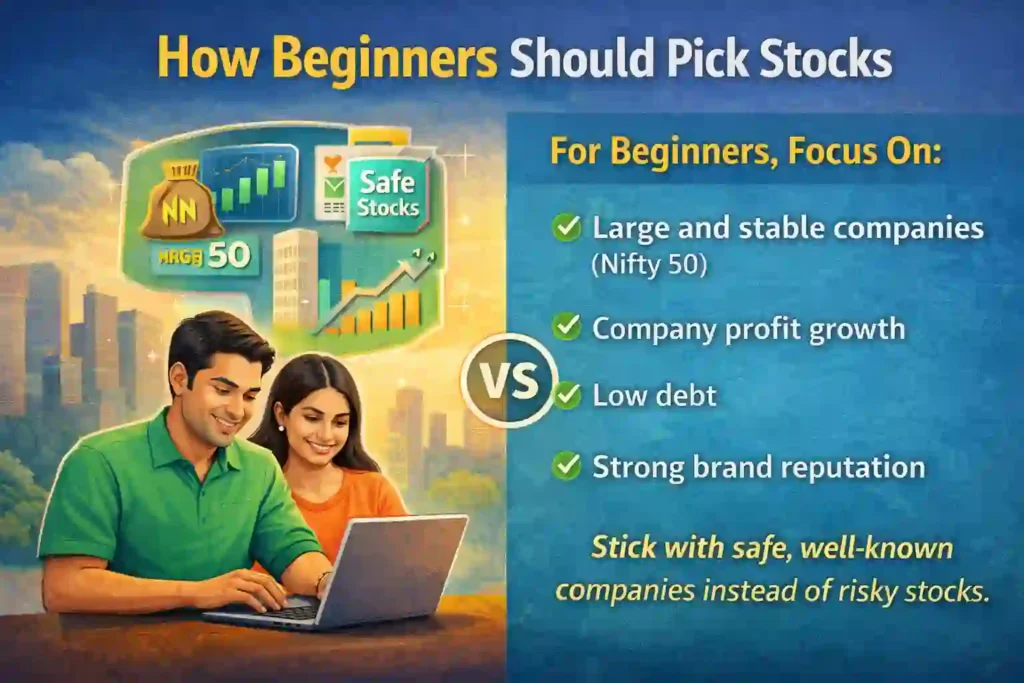
Start with large and stable companies, especially those included in the Nifty 50 index. These companies are market leaders and usually more stable than small or unknown businesses.
Check a few basic things before investing:
- Company profit growth over the last few years
- Low or manageable debt
- Good reputation and strong brand value
- Consistent business performance
You do not need advanced analysis in the beginning. Avoid penny stocks or stocks that promise quick returns. If something looks too good to be true, it usually is.
Simple Beginner Portfolio Strategy
Do not invest all your money in one stock. Spread your investment across different companies.
A simple beginner strategy can be:
- Majority in large cap stocks
- Some portion in index funds for stability
- Small portion in mid cap stocks if you want slightly higher growth
This balanced approach reduces risk and helps you learn slowly. Focus on long term growth instead of short term price movements.
Step 7 – Place Your First Stock Order
Now that you have selected a stock and added funds to your account, it is time to place your first order. Do not rush. Take a moment to review the price and quantity before confirming.
How to Buy a Stock
- Search for the company name in your broker app.
- Click on the stock to open its details page.
- Tap on the Buy option.
- Enter the number of shares you want to purchase.
- Choose the order type.
If you select Market Order, the stock will be bought instantly at the current price.
If you select Limit Order, you can set the price at which you want to buy. The order will execute only if the stock reaches that price.
After checking all details, confirm the order. Once executed, the shares will appear in your holdings section.
What to Do After Buying
Investing does not end after placing the order.
- Track company performance every few months.
- Review your portfolio once every three to six months.
- Avoid checking prices every hour.
- Stay patient and focus on long term growth.
Your first investment is an important step. Start small, learn continuously, and build confidence over time.
Common Mistakes Beginners Should Avoid
Starting in the stock market is exciting, but many beginners lose money because of simple mistakes. Avoid these common errors to protect your capital and grow steadily.
Investing Without Clear Goals
Many people invest just because others are doing it. Without a clear goal like retirement, buying a house, or long-term wealth creation, you may take wrong decisions or exit too early. Always know why you are investing.
Putting All Money in One Stock
Some beginners invest all their savings in one company hoping for big returns. This is risky. If that stock falls, your entire investment suffers. Always diversify across multiple good companies or index funds.
Trading Without Proper Knowledge
Short-term trading looks attractive but carries high risk. Many beginners jump into intraday or options trading without understanding charts, risk management, or market behavior. Start with long-term investing before trying trading.
Following Tips Blindly
Avoid investing based on social media tips, WhatsApp messages, or friends’ advice without doing your own research. Not every tip is reliable. Always check company fundamentals and verify information.
Ignoring Charges and Fees
Brokerage, taxes, and other charges may look small but can reduce your profits over time. Understand all costs before placing trades, especially if you trade frequently.
Avoiding these mistakes will help you stay disciplined and build wealth steadily over time.
How to Start Investing in the Stock Market the Right Way
Starting your stock market journey is simple when you follow the right steps. First, choose a trusted and SEBI-registered broker that fits your needs. Next, open your Demat and Trading account and understand the basic charges involved.
Before investing, clearly decide your financial goals and how much money you can comfortably invest without affecting your daily expenses. Beginners should focus more on long term investing instead of short term trading. Start small, invest in strong and well-known companies, and diversify your portfolio to reduce risk.
Take time to understand your broker’s trading platform, learn the basics of stock selection, and avoid rushing into decisions. Do not follow random tips or invest based on emotions. Most importantly, stay patient and consistent. Wealth in the stock market is built slowly through discipline and long term thinking. If you start carefully and keep learning, you will be on the right path to financial growth.
Leave a Reply