
What Is Demat Account?
A Demat account is an electronic account used to store your investments in digital form. Instead of holding physical share certificates on paper, all your securities are safely kept online in a Demat account.
When you buy shares, mutual funds, bonds, or ETFs from the stock market, they are credited to your Demat account. When you sell them, they are automatically debited. This makes investing faster, safer, and paper-free.
Think of a Demat account like a digital locker for your investments, similar to how a bank account stores money. Just as you cannot trade stocks without money in your bank account, you cannot buy or sell shares without a Demat account.
In India, having a Demat account is mandatory for anyone who wants to invest or trade in the stock market.
What Does a Demat Account Hold?
A Demat account can hold many types of financial securities in one place, such as:
- Shares (Equity stocks)
- Mutual fund units
- Exchange Traded Funds (ETFs)
- Bonds and debentures
- Government securities
- IPO allotments
- Bonus and rights shares
All these assets are stored electronically and can be viewed anytime through your broker’s app or website. You do not need to worry about loss, damage, or forgery, as everything is maintained digitally by authorized depositories like NSDL and CDSL.
In short, a Demat account helps you buy, sell, hold, and track investments easily, making it an essential tool for every modern investor.
Full Form of Demat Account
The full form of Demat is Dematerialised Account.
In simple words, a Demat account is used to store your shares and other investments in electronic (digital) form instead of paper form.
Earlier, investors used to receive physical share certificates, which were difficult to store and easy to lose or damage. A Demat account removes this problem by converting those paper certificates into digital records that can be accessed anytime online.
What Does “Dematerialised” Mean?
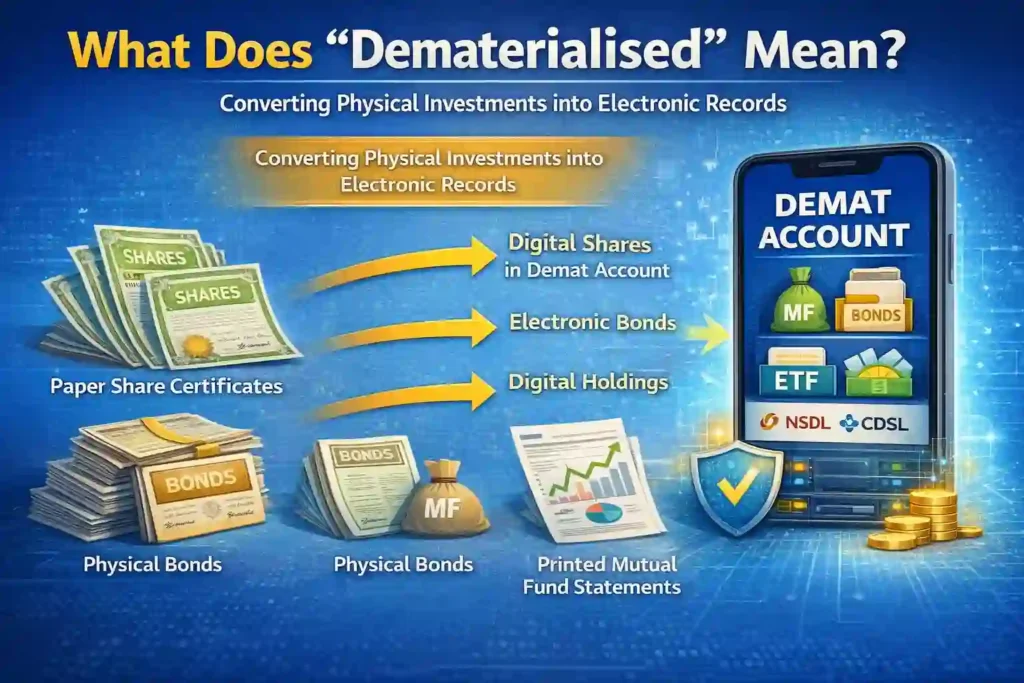
The term dematerialised means converting physical assets into electronic form.
For example:
- Paper share certificates → Digital shares in Demat account
- Physical bonds → Electronic bonds
- Printed mutual fund statements → Digital holdings
Once securities are dematerialised, they are safely stored with government-regulated depositories like NSDL and CDSL, and you can view them easily through your broker’s app or website.
This process:
- Eliminates paperwork
- Reduces the risk of loss, theft, or forgery
- Makes buying and selling shares faster and smoother
In short, a Dematerialised Account (Demat Account) acts like a digital locker for your investments, making modern investing simple, secure, and hassle-free.
History of Demat Account in India
Before Demat accounts were introduced, investors in India had to deal with physical share certificates. These paper-based certificates were difficult to store and came with many problems such as loss, theft, damage, fake shares, and long transfer delays. Buying or selling shares could take weeks or even months to complete.
To solve these issues and modernize the Indian stock market, the Demat account system was introduced in the mid-1990s. This change made investing safer, faster, and more transparent for investors.
Role of SEBI in Introducing Demat Accounts
The Securities and Exchange Board of India (SEBI) played a key role in bringing Demat accounts to India. In 1996, SEBI made it mandatory to hold shares in electronic form for trading on major stock exchanges.
SEBI introduced Demat accounts to:
- Reduce fraud and fake share certificates
- Speed up share transfer and settlement
- Improve transparency in the stock market
- Protect investor interests
With SEBI’s regulations, physical shares were gradually replaced by electronic holdings, making Demat accounts the standard way to invest in securities in India.
NSDL and CDSL – India’s Depositories Explained
To manage electronic securities, India needed reliable institutions called depositories. This led to the creation of two major depositories:
- National Securities Depository Limited (NSDL) – launched in 1996, it was India’s first depository and played a major role in starting Demat services.
- Central Depository Services Limited (CDSL) – launched in 1999, it further strengthened the Demat system by offering similar services.
These depositories do not directly deal with investors. Instead, they work through Depository Participants (DPs) such as banks and stockbrokers, who open and manage Demat accounts for investors.
Today, NSDL and CDSL together handle millions of Demat accounts, making India’s stock market one of the most efficient and secure markets in the world.
What Is a DP Account?
A DP account is closely connected to your Demat account and plays a key role in holding and managing your investments. DP stands for Depository Participant. It is the authorized entity that opens and maintains your Demat account on your behalf.
In simple words, a DP acts as a bridge between you and the depository (NSDL or CDSL). You do not open a Demat account directly with NSDL or CDSL. Instead, you open it through a DP such as a stockbroker or bank.
Who Is a Depository Participant (DP)?
A Depository Participant (DP) is a SEBI-registered intermediary that provides Demat account services to investors. DPs are approved by depositories like NSDL and CDSL to offer electronic holding of securities.
Common examples of DPs include:
- Stockbrokers (Zerodha, Groww, Angel One, Upstox)
- Banks (SBI, ICICI Bank, HDFC Bank)
- Financial institutions and NBFCs
The DP is responsible for:
- Opening your Demat account
- Safely holding your shares in electronic form
- Crediting shares when you buy
- Debiting shares when you sell
- Providing account statements and transaction details
Without a DP, it is not possible for an investor to access the Demat system.
What Is DP ID and Why Is It Important?
A DP ID is a unique identification number assigned to every Depository Participant by NSDL or CDSL. This ID helps identify which DP is managing your Demat account.
Your Demat account number is created using:
- DP ID (identifies the DP)
- BO ID (Beneficiary Owner ID) or Client ID (identifies you)
Together, they form your complete Demat account number.
Example formats:
- NSDL Demat Account: Starts with IN followed by numbers
- Example: IN12345678901234
- CDSL Demat Account: 16-digit numeric number
- Example: 1234567890123456
The DP ID is important because:
- It links your Demat account to a specific broker or bank
- It helps track transactions accurately
- It is required for transfers and account verification
You can find your DP ID in your welcome email, Demat account statement, or broker app/profile section.
Simple Way to Understand DP vs Demat Account
- Demat Account → Where your shares are stored
- DP (Depository Participant) → The service provider who manages that account
Think of it like this:
- Bank = Depository Participant
- Savings Account = Demat Account
Both work together to keep your investments safe and organized.
How Does a Demat Account Work?
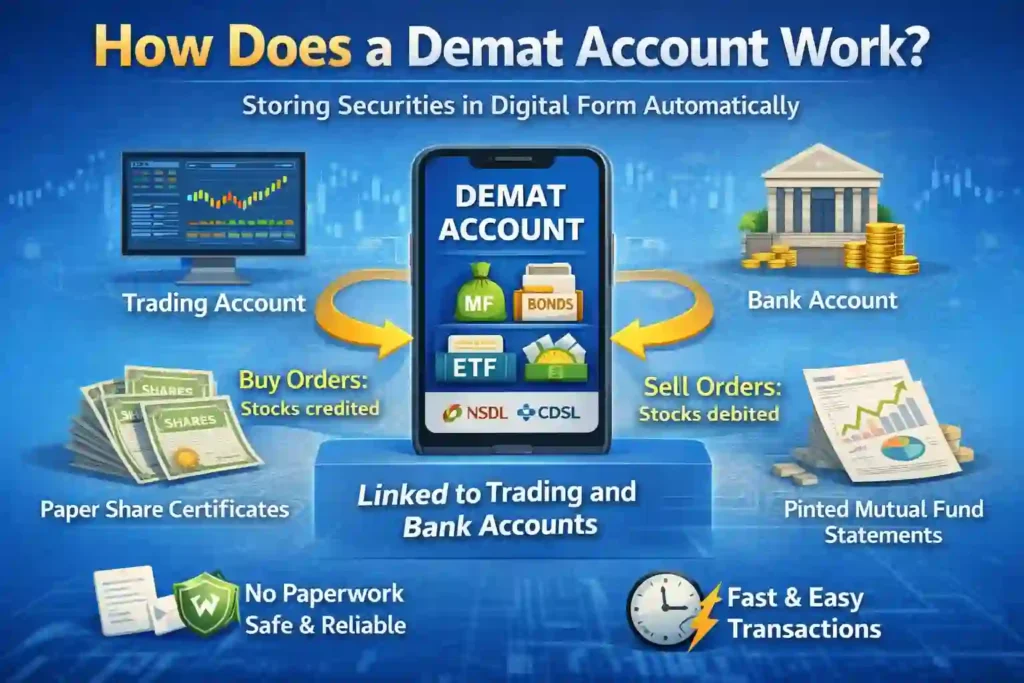
A Demat account works like a digital locker that safely stores your shares, mutual funds, bonds, and other securities in electronic form. It is connected to your trading account (for buying and selling) and bank account (for payments), making investing simple, fast, and paperless.
Whenever you buy or sell a security, the Demat account automatically updates your holdings without any physical paperwork.
Demat Account Opening Process
To start investing, you first need to open a Demat account through a Depository Participant (DP) such as a bank or stockbroker.
The process includes:
- Choosing a DP (broker or bank)
- Submitting KYC documents like PAN and Aadhaar
- Linking your bank account and trading account
- Completing e-KYC through OTP or video verification
Most brokers complete this process online, and the Demat account is usually activated within 24 hours.
How Buying Shares Works Through a Demat Account
When you buy shares, the process happens electronically:
- You place a buy order using your trading account
- The order goes to the stock exchange (NSE or BSE)
- Once a seller is found, the trade is executed
- The money is debited from your linked bank account
- The purchased shares are credited to your Demat account
This settlement usually happens on a T+1 basis, meaning shares are credited the next working day.
How Selling Shares Works Through a Demat Account
Selling shares is just as simple:
- You place a sell order through your trading account
- The shares are debited from your Demat account
- The trade is matched on the stock exchange
- After settlement, the sale amount is credited to your bank account
You don’t need to submit any physical documents—everything is handled digitally.
Integration With Trading Account and Bank Account
A Demat account does not work alone. It is always connected to:
- Trading account – to place buy and sell orders
- Bank account – to receive and pay money
This three-way linkage ensures:
- Smooth fund transfers
- Automatic credit and debit of securities
- Faster settlements without manual intervention
Because of this integration, investing becomes seamless and hassle-free.
Corporate Actions in a Demat Account (Dividend, Bonus, Split)
All corporate actions are automatically reflected in your Demat account, such as:
- Dividends – directly credited to your bank account
- Bonus shares – added to your Demat holdings
- Stock splits – share quantity adjusts automatically
- Rights issues – credited if you participate
You don’t need to apply separately or submit documents—everything is handled electronically by the depository.
Documents Required to Open a Demat Account
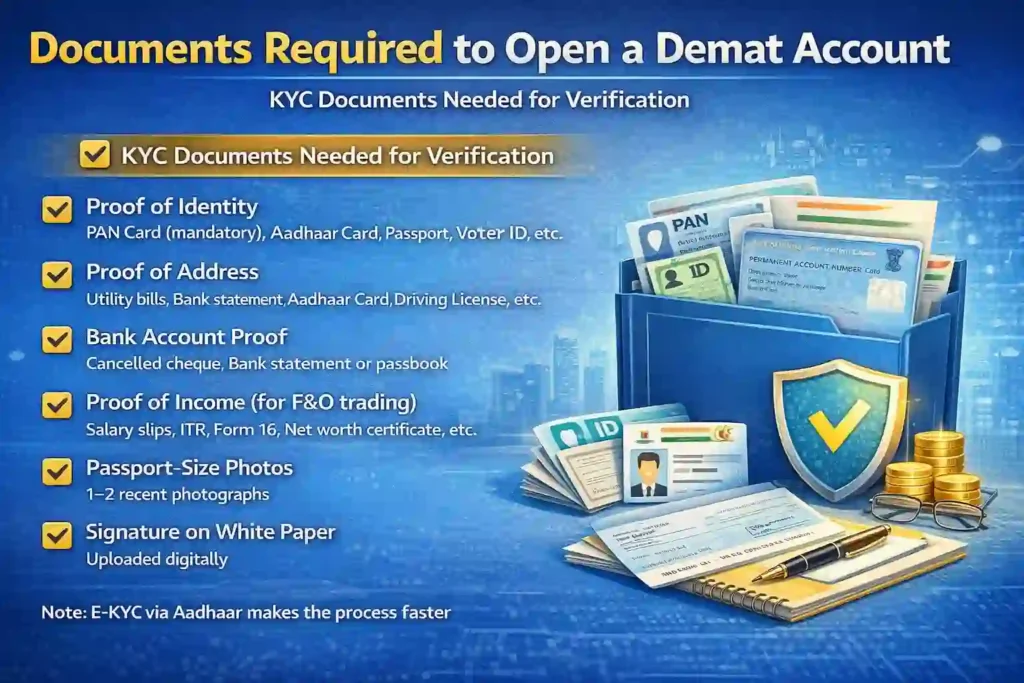
To open a Demat account in India, you need to submit a few Know Your Customer (KYC) documents. These documents help verify your identity, address, and bank details, as required by SEBI.
The good news is that most brokers complete this process online, and your account can be activated within 24 hours.
Proof of Identity (POI)
Proof of Identity is used to confirm who you are.
PAN card is mandatory for opening a Demat account, as per SEBI rules.
Accepted documents include:
- PAN Card (compulsory)
- Aadhaar Card
- Passport
- Voter ID
- Driving License
- Any government-issued photo ID from central or state authorities, banks, PSUs, or recognized professional bodies
Make sure the name on your PAN card matches your other documents to avoid verification delays.
Proof of Address (POA)
Proof of Address confirms where you currently live. You can submit any one valid address document from the list below:
Accepted documents:
- Aadhaar Card
- Passport
- Voter ID
- Driving License
- Ration Card
- Latest utility bill (electricity, gas, water, or broadband – not older than 3 months)
- Bank statement or passbook (last 3 to 6 months)
- Registered rent or lease agreement
If your address has changed, update it in Aadhaar or bank records before applying.
Bank Account Proof
Your Demat account must be linked to a bank account for buying and selling shares.
For bank verification, submit any one of the following:
- Cancelled cheque with your name printed
- Bank statement showing account number and IFSC code
- Bank passbook copy
- Bank verification letter issued by the bank
This ensures smooth fund transfers during trading and settlements.
Proof of Income (Required for F&O Trading)
Proof of income is not mandatory for equity investing, but it is required if you want to trade in Futures and Options (F&O) or other derivative segments.
Accepted income documents include:
- Latest salary slips
- Form 16
- Income Tax Return (ITR) acknowledgment
- Bank statement of the last 6 months showing income
- Net worth certificate issued by a Chartered Accountant (CA)
Other KYC Requirements
In addition to the above documents, brokers may also ask for:
- 1–2 recent passport-size photographs
- Signature on plain white paper (uploaded digitally)
Most brokers now offer e-KYC using Aadhaar, where documents are verified online through OTP or video verification, making the process quick and paperless.
Types of Demat Account in India
In India, Demat accounts are classified mainly based on the investor’s residency status and investment needs. These accounts are offered through depositories like NSDL and CDSL via registered banks and stockbrokers (Depository Participants). Choosing the right type of Demat account helps reduce costs and ensures regulatory compliance.
There are four main types of Demat accounts in India, explained below in simple terms.
Regular Demat Account
A Regular Demat Account is designed for resident Indian investors. It is the most commonly used type of Demat account and is suitable for people who invest in shares, mutual funds, bonds, ETFs, and other securities.
There is no limit on the value of holdings in a regular Demat account. Investors can buy, sell, and hold securities freely through their linked trading account. Most brokers charge an Annual Maintenance Charge (AMC) for this account, usually ranging from ₹500 to ₹999 per year, depending on the broker.
This account is ideal for long-term investors, traders, and beginners who want a standard investing setup.
Basic Services Demat Account (BSDA)
A Basic Services Demat Account (BSDA) is a low-cost option introduced by SEBI for small retail investors. It is suitable for people who invest occasionally or hold a limited value of securities.
If the value of holdings is up to ₹2 lakh, there is zero AMC. For holdings above ₹2 lakh and up to ₹10 lakh, a nominal AMC is charged. However, the investor must have only one Demat account across all depositories to be eligible for BSDA.
BSDA is best for beginners, salaried individuals, and small investors who want to keep costs minimal.
Repatriable Demat Account (For NRIs)
A Repatriable Demat Account is meant for Non-Resident Indians (NRIs) who want to invest in Indian securities and also transfer their funds abroad.
This account must be linked to an NRE (Non-Resident External) bank account, allowing both investment and repatriation of money outside India. It is commonly used by NRIs investing in Indian stocks, mutual funds, and bonds.
Repatriable Demat accounts follow RBI and FEMA guidelines and are suitable for NRIs who plan to move money internationally.
Non-Repatriable Demat Account (For NRIs)
A Non-Repatriable Demat Account is also designed for NRIs, but the funds in this account cannot be transferred abroad.
It is linked to an NRO (Non-Resident Ordinary) bank account and is mainly used for managing income earned in India, such as rent, dividends, or pensions. Investments made through this account remain within India.
This type of Demat account is ideal for NRIs who want to invest or manage Indian income locally without repatriating funds.
Quick Comparison of Demat Account Types
- Resident Indians → Regular Demat Account or BSDA
- Small investors → BSDA
- NRIs (with repatriation needs) → Repatriable Demat Account
- NRIs (without repatriation needs) → Non-Repatriable Demat Account
Demat Account Number and DP ID Explained
A Demat account number is a unique identification number given to every investor who opens a Demat account. Just like a bank account number helps identify your savings account, a Demat account number helps identify who owns which shares and securities in electronic form.
This number is used to track your shares, mutual funds, ETFs, and bonds held with depositories such as NSDL or CDSL. It also plays an important role during buying, selling, and transferring securities.
Structure of a Demat Account Number
A Demat account number always has 16 characters. It is made up of two parts:
- DP ID (Depository Participant ID) – first 8 characters
- BO ID (Beneficiary Owner ID) – last 8 characters
Together, these two parts form your complete Demat account number.
For example:
12345678 90123456
Here:
- 12345678 → DP ID
- 90123456 → BO ID (your unique client number)
Each investor gets a unique BO ID, while many investors can share the same DP ID if they use the same broker or bank.
Difference Between NSDL and CDSL Demat Account Numbers
In India, Demat accounts are maintained by two depositories:
- NSDL (National Securities Depository Limited)
- CDSL (Central Depository Services Limited)
The format of the Demat account number differs slightly between the two:
NSDL Demat Account
- Starts with “IN”
- Followed by 14 digits
- Example: IN56732892132810
- IN567328 → DP ID
- 92132810 → BO ID
CDSL Demat Account
- Consists of 16 digits only
- Example: 1234567890123456
- 12345678 → DP ID
- 90123456 → BO ID
Both formats serve the same purpose; the difference is only in how the number looks.
How to Find Your Demat Account Number and DP ID
You can easily find your Demat account number and DP ID using any of the following methods:
- Welcome email or letter sent by your broker after account activation
- Demat account statement or Client Master Report (CMR)
- Broker’s mobile app or website, usually under Profile or Account Details
- Monthly CAS (Consolidated Account Statement) sent to your registered email
- Depository websites (NSDL or CDSL) using your PAN details
Most brokers clearly display the Demat account number once you log in, so you usually don’t need to search hard.
Why Demat Account Number and DP ID Are Important
- They help identify ownership of shares
- Required for off-market share transfers
- Used for pledging shares for loans
- Needed for resolving account-related issues
- Essential for tracking investments across platforms
In simple terms, your Demat account number and DP ID ensure that your investments stay correctly mapped to you, safely and digitally.
Demat Account Charges
A Demat account comes with certain charges that are levied by your Depository Participant (DP), such as a bank or stockbroker. These charges can vary depending on the broker, account type, and how frequently you trade. Most fees also attract GST.
Understanding these charges in advance helps you choose the right broker and avoid unexpected costs.
Demat Account Opening Charges
Demat account opening charges are the one-time fees paid when you open a new account.
Many discount brokers offer free Demat account opening, while some full-service brokers may charge between ₹100 and ₹500. In several cases, brokers waive off the opening fee during promotional offers.
The first year’s maintenance fee is also often free.
Annual Maintenance Charges (AMC)
Annual Maintenance Charges (AMC) are the recurring fees paid to maintain your Demat account.
For a regular Demat account, AMC usually ranges between ₹300 and ₹800 per year, charged either annually or quarterly, plus GST.
For Basic Services Demat Account (BSDA) holders:
- No AMC if the total holding value is up to ₹4 lakh
- A nominal AMC is charged if holdings exceed this limit (up to ₹10 lakh, as per SEBI rules)
Transaction Charges
Transaction charges are applied when securities are debited from your Demat account, mainly during selling.
Typically, brokers charge ₹10 to ₹30 per ISIN for each debit transaction, plus GST.
Buying shares (crediting securities) is usually free, but off-market transfers or inter-DP transfers may attract charges.
Other Demat Account Fees to Know
Apart from AMC and transaction charges, some additional fees may apply:
- Demat account statement charges: ₹50–₹100 per request
- Modification charges: Around ₹100 for changes like name or signature
- Dematerialization charges: ₹25–₹50 per certificate
- Inactive account charges: Some brokers charge fees if the account remains unused for a long period
- Pledge/unpledge charges: Applicable when using shares as collateral for loans or margin trading
Benefits of a Demat Account
A Demat account makes investing simple, safe, and efficient by allowing you to hold all your securities in electronic form. It removes the problems of physical share certificates and offers several advantages to investors in India.
Convenience and Faster Settlements
A Demat account makes buying and selling shares quick and hassle-free. Once you place a trade through your trading account, the shares are automatically credited or debited from your Demat account without any paperwork.
Today, stock market transactions are settled in T+1 days, meaning you receive shares or money very fast. You can also check your investments anytime using mobile apps or online portals, making portfolio tracking easy.
Enhanced Security
Holding shares in a Demat account is much safer than keeping physical certificates. There is no risk of loss, theft, forgery, or damage because everything is stored digitally with depositories like NSDL and CDSL.
Demat accounts also offer features like nominee facility, secure login, and transaction alerts, which add an extra layer of protection to your investments.
Cost Savings
Demat accounts help reduce many costs involved with physical shares. You save money on stamp duty, courier charges, paperwork, and handling fees.
Dividends, bonus shares, and interest are directly credited to your bank or Demat account, saving time and effort. Online trading platforms also offer lower brokerage charges, which further reduces overall investing costs.
Versatility and Multiple Asset Holding
A single Demat account can hold different types of investments such as shares, mutual funds, ETFs, bonds, and government securities. This makes it easy to manage all your investments in one place.
You can also pledge securities from your Demat account to take loans, use it for margin trading, and easily monitor your entire portfolio without maintaining multiple accounts.
Is a Demat Account Safe in India?
Yes, a Demat account is very safe in India. It is regulated by the Securities and Exchange Board of India (SEBI) and managed through authorized depositories like NSDL and CDSL. These institutions follow strict security standards to protect investors.
All shares and securities are stored in electronic form, which removes risks linked to physical certificates such as theft, loss, damage, or forgery. Demat accounts also use password protection, two-factor authentication, and encrypted systems, making unauthorized access difficult.
In addition, investors can add a nominee to their Demat account, ensuring smooth transfer of holdings in case of unforeseen events. Regular account statements and transaction alerts further improve transparency and control.
Overall, as long as you open your Demat account with a SEBI-registered broker or bank, it is a safe and reliable way to invest in the Indian stock market.
Who Should Open a Demat Account?
A Demat account is suitable for anyone who wants to invest or trade in the Indian financial markets. You should consider opening one if:
- You want to buy or sell shares of listed companies
- You plan to invest in mutual funds, ETFs, bonds, or government securities
- You are a beginner investor starting your investment journey
- You are a long-term investor building wealth over time
- You want to trade in F&O (futures and options)
- You are an NRI looking to invest in Indian markets
Even students and salaried professionals can open a Demat account with basic documents. There is no minimum investment requirement, making it accessible to everyone.
Why a Demat Account Is Essential for Investors Today
A Demat account has become a basic requirement for investing in today’s digital financial world. It offers a safe, paperless, and convenient way to hold and trade securities without the hassles of physical certificates.
With faster settlements, better security, lower costs, and easy access through mobile apps, a Demat account simplifies investing for both beginners and experienced investors. Whether you want to invest small amounts or actively trade in the stock market, a Demat account makes the entire process smooth and efficient.
If you are serious about building wealth through investments, opening a Demat account is the first and most important step
Want to open a demat account?
Leave a Reply